

ChatGPT for stocks: is there an AI that gives real analysis?
ChatGPT gives generic, hedged stock answers because it lacks live market data and finance-specific reasoning. Here is what real AI stock analysis looks like and which tools actually deliver it.


Peakwise Team
Editorial
If you've typed a ticker into ChatGPT and asked "should I buy this stock?", you already know the frustration. You get a carefully hedged non-answer: "This stock has both risks and opportunities. Past performance doesn't guarantee future results. Please consult a financial advisor." Technically true. Completely useless.
The question isn't whether AI can analyze stocks. It's whether the right AI, built for this specific job, actually can.
Why ChatGPT gives generic stock answers
ChatGPT is a general-purpose language model. It was trained to be helpful across every topic imaginable, which means it's optimized to avoid being wrong rather than to give you a conviction-based investment thesis. There are a few structural reasons this happens.
First, the base model has no live market data. Without real-time quotes, current earnings reports, or today's sentiment signals, any answer about a specific stock is either outdated or hedged so broadly it carries no signal. As AlphaLog.ai noted in a December 2025 review, "base ChatGPT cannot access live market data" and is therefore unsuitable as a primary analysis tool.
Second, ChatGPT isn't wired to run multiple analytical frameworks simultaneously. A proper stock assessment means weighing fundamentals against technicals, layering in macro context, and cross-referencing sentiment, all at once. A single general-purpose chat model runs these tasks sequentially, if at all, and often drops the thread between steps.
Third, and most importantly, it hedges by design. Reddit's r/stocks community has documented this repeatedly: the same stock question phrased two different ways can generate radically different outputs, with neither version grounded in current data.
What real stock analysis actually requires
Before evaluating any AI tool, it helps to define what "real analysis" means. A proper investment research workflow covers at minimum:
- Fundamentals: Revenue growth, margins, earnings trends, debt levels, free cash flow
- Valuation: P/E, forward P/E, EV/EBITDA, DCF-based fair value estimates
- Technicals: Support/resistance levels, RSI, MACD, moving averages
- Sentiment: News tone, analyst ratings, social sentiment, insider activity
- Macro context: How interest rate moves, sector rotation, and geopolitical events affect the specific company
- Risk: What could go wrong, and how exposed the stock is to those scenarios
An analyst at a fund runs all of these in parallel before forming a view. A single chat prompt to a general AI model doesn't come close.
Finance-specific AI tools that go deeper
The market has responded to this gap. A handful of platforms now deliver analysis that's meaningfully more structured than ChatGPT, though they differ significantly in how deep they go.
Peakwise is the platform most directly built around this exact problem. Rather than routing your question through a single large language model, it runs 10+ specialized AI agents simultaneously: one for fundamentals, one for technicals, one for macro, one for sentiment, one for valuation, one for risk, and so on. Type in a ticker and you get a structured investment analysis that covers all six dimensions above, generated in seconds from real-time market data.
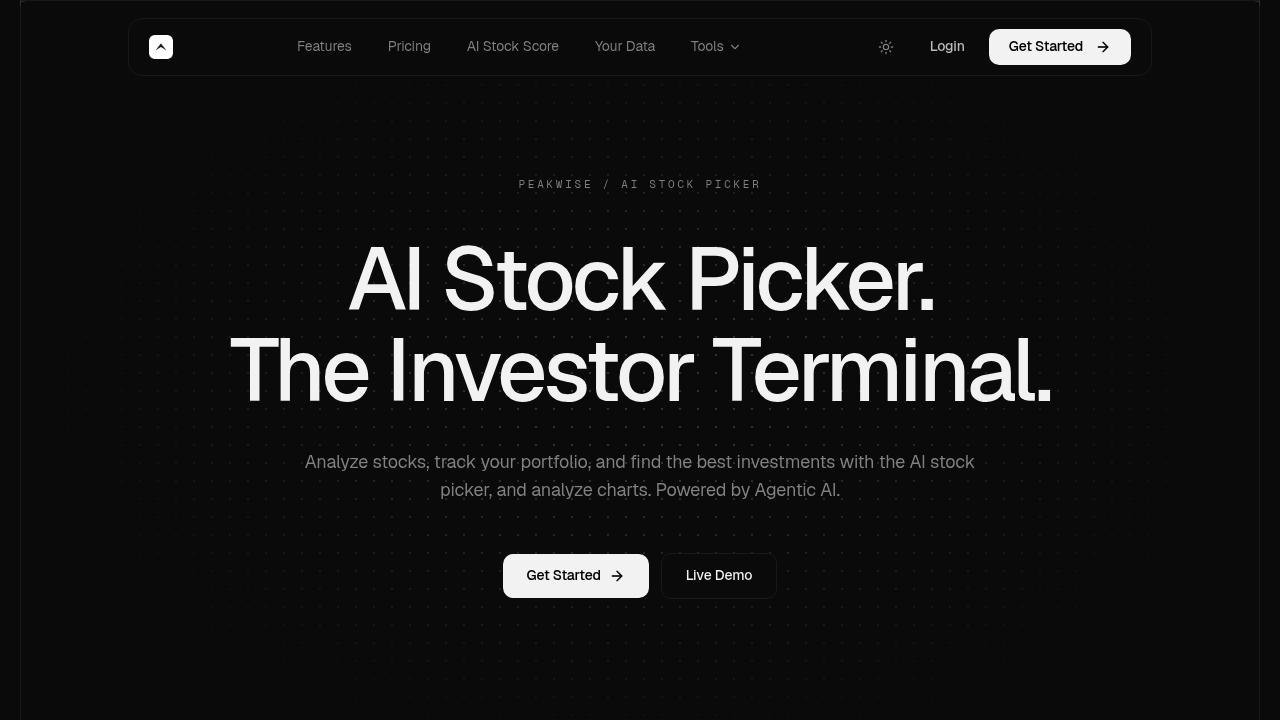
What separates Peakwise from simply using ChatGPT with a good prompt is the architecture behind it. Its AI Stock Picker Scores cover 500+ stocks across 47 metrics, updated daily. The platform's AI economic calendar connects macro events directly to how they move individual holdings. You also get chart analysis with RSI, MACD, Bollinger Bands, and support/resistance levels, not as separate tools, but inside the same terminal. The output includes fair value estimates, confidence levels, and actual recommendation signals, not diplomatic non-answers.
For investors who still want ChatGPT, Claude, or Gemini in the mix, Peakwise offers model-agnostic access — you can switch between its default Peak AI system and any major general model within the same workflow. The finance-specific orchestration layer is what makes the difference, not the underlying model alone.
TrendSpider covers technical analysis and automated chart recognition well, particularly for traders who focus on pattern-based setups. Prospero.ai brings institutional-grade options flow data into the picture, useful for options traders and those tracking smart money positioning.
For a broader look at what these tools produce, the Peakwise blog publishes structured AI-driven stock analyses on individual companies. It is a good way to see what depth looks like in practice before committing to a platform.
The prompt engineering workaround (and why it falls short)
Some investors have tried to solve the ChatGPT problem through prompt engineering: forcing the model to adopt a specific persona ("Act as a value investor"), constraining its output format ("Give me a bull case, bear case, and valuation estimate"), or manually feeding it earnings data copied from SEC filings.
This approach produces better results than a basic query. But it has real limits. You're still supplying the data manually, which means you need to know where to find it, how current it is, and whether ChatGPT is processing it correctly. Research from r/pennystocks in 2026 confirmed the core frustration: "it gives balanced, generic responses instead of how it actually looks." Prompts help, but they don't replace a system designed from the ground up for this job.
The deeper issue is maintenance. Building a reliable research workflow on top of a general chat tool means you're rebuilding it every time the model updates, every time the API changes, and every time you need a different type of analysis. Dedicated platforms absorb that friction.
What to look for in a real AI stock analysis tool
If you're evaluating options, a few criteria separate the serious tools from the marketing-heavy ones:
- Real-time data integration. Not scraped summaries from yesterday, but live quotes and current fundamentals.
- Multi-factor coverage. The tool should handle fundamentals, technicals, sentiment, and macro in one place, not force you to stitch them together.
- Interpretable output. Fair value estimates, confidence levels, and directional signals you can act on, not just summaries.
- Auditability. You should be able to trace why the AI reached a conclusion, not just receive it.
- Portfolio context. A stock doesn't exist in isolation; analysis that ignores how it interacts with your existing holdings misses a major variable.
Peakwise's investor terminal addresses all five. Most general AI tools handle one or two.
The honest answer
Yes, there is a "ChatGPT for stocks" that gives real analysis, but it isn't ChatGPT. It's a new category of finance-specific AI platforms that use the same underlying model technology but wire it into financial data infrastructure, multi-agent reasoning, and structured output formats designed for actual investment decisions.
For self-directed investors tired of generic hedging and diplomatic non-answers, these platforms are now genuinely capable of replacing hours of fragmented manual research with a structured analysis in under a minute. The technology exists. You just need the right implementation of it.
Frequently Asked Questions
Topics
Start with AI Stock Scoring
Score stocks with our AI Stock Score and make informed decisions.