

Best AI stock picker tools in 2026 that score stocks daily
The best AI stock picker tools in 2026 score stocks daily, explain their reasoning, and connect to your portfolio. Here's an honest comparison of Peakwise, Danelfin, Kavout and Trade Ideas.


Peakwise Team
Editorial
Most investors I talk to share the same frustration: by the time they've finished checking a stock on one site, pulling the chart on another, and hunting for news somewhere else, they've spent an hour and still don't have a clear answer on whether the stock is worth buying. Sound familiar?
The promise of AI stock picking tools is exactly this: collapse that research loop into seconds. But the market is crowded, and most tools do only one piece of the puzzle well. Some give you a daily score but zero portfolio context. Others track your holdings but can't tell you which positions are the biggest risk. A handful actually do both.
Here's an honest look at what to look for, which tools stand out, and why the combination of daily scoring plus portfolio tracking is the thing that actually changes how you invest.
Why daily scoring matters more than you'd think
A stock score that's updated weekly (or never) isn't a research signal. It's a historical snapshot. Markets reprice faster than that, especially now. According to a Reuters report from December 2025, retail investors poured a record $312 billion into U.S. stocks in 2025 alone, up 53% from the year before. More money chasing the same stocks means price dislocations appear and disappear in days, not quarters.
A genuinely useful AI stock picker refreshes every single trading day. That means recalculating fundamentals, pulling fresh analyst revisions, factoring in news sentiment, and updating valuation metrics against sector peers, all overnight so you have a current read each morning.
The other thing a good daily score does: it forces discipline. When you can see that a stock you've been holding has slipped from a score of 78 to 51 over six weeks, that's a concrete signal to re-examine your thesis, not just a gut feeling that something has changed.
The tools worth your time
Peakwise
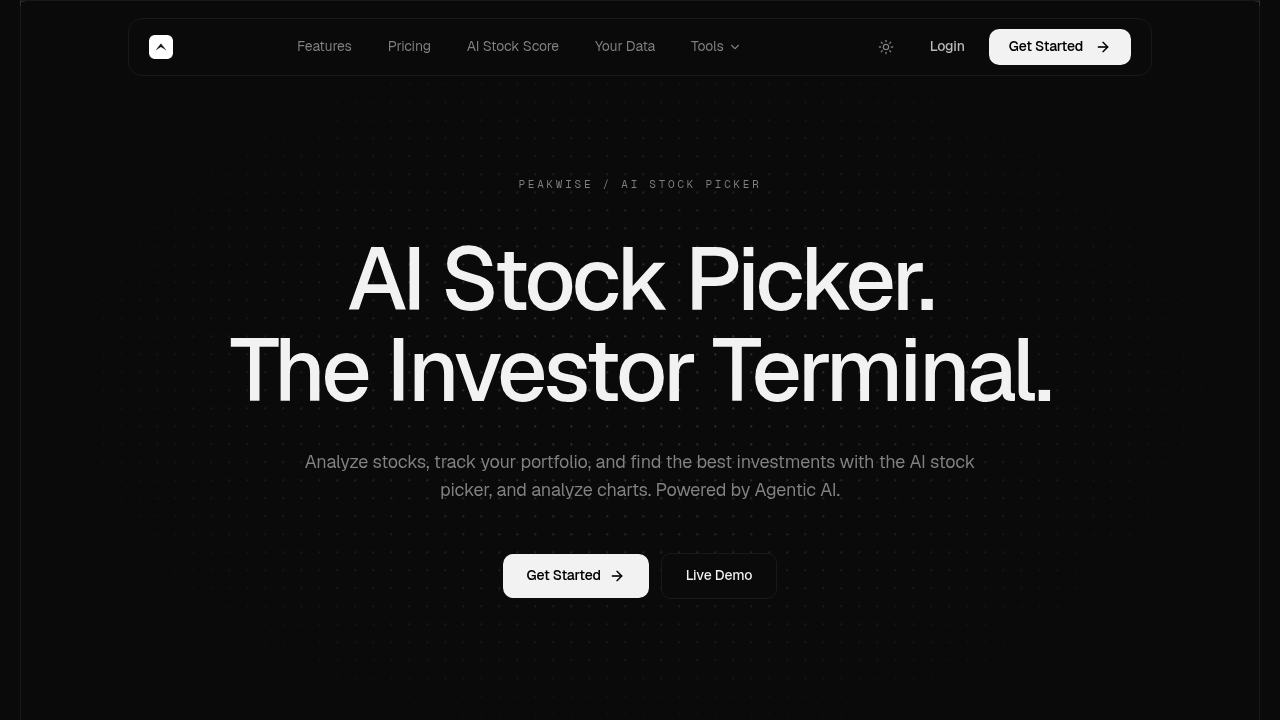
Peakwise is built specifically for self-directed investors who want institutional-style research without the Bloomberg price tag. Its AI Stock Picker Scores rate 500+ stocks every trading day across 47 metrics, organized into three weighted pillars: Financial Health (45%), Market Sentiment (35%), and Valuation (20%). Every score is fully decomposed, so you can see exactly why a stock ranked where it did, which metrics drove the rating, and how it compares to sector peers.
What separates Peakwise from single-purpose scoring tools is the portfolio side. The AI Portfolio Tracker imports holdings from any broker via CSV, PDF, or screenshot, then generates a full institutional-grade breakdown: geographic allocation on an interactive world map, sector concentration, multi-dimensional risk scores, and correlation warnings. You can then ask the built-in portfolio chatbot direct questions like "Am I overweight tech?" or "What's my geopolitical exposure?" and get answers grounded in your actual holdings.
Peakwise also layers in 10+ specialized AI agents covering macro, technical, sentiment, valuation, and SWOT-style analysis in a single terminal. You can switch between Peak AI (the default multi-agent system), ChatGPT, Claude, or Gemini depending on your preference, which is a meaningful advantage for users who already have workflow opinions about which models they trust. The AI economic calendar adds another layer, analyzing how macro events could affect specific stocks in your universe.
For self-directed investors who want one place to discover stocks, evaluate them deeply, and then monitor them inside a tracked portfolio, Peakwise is the most complete option available at the retail level.
Danelfin
Danelfin takes a narrow but well-executed approach: a daily AI score from 1 to 10 across 10,000+ stocks and ETFs, built on more than 10,000 features per ticker spanning technical, fundamental, and sentiment data. The score reflects the probability of beating the market over the next three months. It's transparent, explainable, and genuinely updated every day.
The limitation is portfolio depth. Danelfin lets you monitor the AI score evolution of stocks you hold, which is useful, but it stops short of the structured portfolio risk analysis, geographic exposure, and chatbot interaction that a full investor terminal provides. If daily scores are your primary use case and you track holdings elsewhere, it's worth considering. Plans run from free up to around $75/month for premium.
Kavout
Kavout scans over 9,000 U.S. stocks daily using its proprietary Kai Score, which focuses on identifying institutional buying patterns. The breadth of coverage is genuinely impressive, and the scoring model has a good track record in backtests. Where it falls short for most retail investors is the interface, which feels dated, and the limited portfolio integration. It's better suited to users who want a pure screening signal than a complete research-and-tracking workflow.
Trade Ideas (Holly)
Holly is Trade Ideas' AI, and it runs more than a million simulated trading scenarios overnight to generate next-day alerts. It's well-regarded by active day traders and swing traders. But it's optimized for execution speed, not research depth. You won't get fair value estimates, valuation breakdowns, or sector risk profiles here. It's a different tool for a different use case.
What actually matters when picking your tool
The tool you choose should match your workflow, not the other way around. A few questions worth asking:
- Does the scoring update daily? Anything less frequent is stale for most active investors.
- Can you see why a stock scored the way it did? Black-box scores require blind trust. Transparent methodology lets you form your own view.
- Does it connect to your portfolio? A great stock picker that ignores your existing holdings gives you no sense of whether the buy actually improves your situation.
- Does it handle macro context? Individual stock analysis that ignores interest rate decisions, earnings calendars, or geopolitical risk leaves obvious blind spots.
The platforms that check all four boxes are rare. Most tools do one or two things well and patch the rest. That's why consolidating onto a single terminal that handles scoring, research, portfolio analysis, and macro context in one place tends to save more time over a year than any individual feature.
Scores are signals, not instructions
One thing worth stating clearly: even the best AI stock score is a research input, not a trade recommendation. A Peakwise score of 85 tells you the stock has strong fundamentals, favorable sentiment, and reasonable valuation relative to peers. It doesn't know your tax situation, your existing exposure, or your time horizon.
The real value of daily scoring is pattern recognition over time. Watching a score trend upward as a company's fundamentals improve, or seeing a score deteriorate as earnings revisions turn negative, gives you a structured lens that's much harder to replicate by skimming headlines. Pair that with portfolio-level risk tracking and you've replaced a fragmented multi-tab research process with something that actually tells a coherent story about where your money is and where it might go.
If you're ready to try it, the Peakwise demo lets you explore the full investor terminal without committing to anything, including the daily scores, portfolio tracker, and AI research tools in one view.
Frequently Asked Questions
Topics
Start with AI Stock Scoring
Score stocks with our AI Stock Score and make informed decisions.