

AI stock analysis: get a full stock breakdown + Tool in seconds (2026)
In 2026, purpose-built AI tools deliver a full stock breakdown — fundamentals, valuation, technicals, sentiment, risk — in seconds. Here's how AI stock analysis actually works and how to use it.


Peakwise Team
Editorial
You've done it before: you spot an interesting ticker, open three browser tabs, pull up a brokerage chart in a fourth, and an hour later you're still not sure whether the stock is actually worth buying. Sound familiar?
The good news is that this workflow is genuinely obsolete in 2026. Purpose-built AI tools can now take a single ticker symbol and return a structured breakdown covering fundamentals, valuation, technicals, sentiment, and risk in the time it takes to pour a coffee. Here's what that actually looks like, what separates the good tools from the mediocre ones, and how to pick the right one for your research style.
What a real AI stock breakdown covers
A surface-level summary is easy to generate. What you actually want from an AI stock analysis tool is institutional-grade depth, delivered in plain language, without requiring you to already know what you're looking for.
The best tools in 2026 produce breakdowns that cover:
- Fundamentals — revenue growth, earnings history, margins, debt load, and cash flow trends
- Valuation — fair value estimates, P/E relative to sector, DCF context, and analyst consensus targets
- Technicals — support and resistance levels, RSI, MACD, moving averages, and chart pattern recognition
- Sentiment — news headlines scored for bullish/bearish tone, social signals, and institutional activity
- Risk and macro context — sector headwinds, geopolitical exposure, interest rate sensitivity, and SWOT-style factors
When all five of those come back in one place, in under a minute, you've effectively compressed an afternoon of research into a single query.
Why general-purpose AI falls short here
ChatGPT, Claude, and Gemini are impressive tools. But ask any of them about a specific stock and you'll quickly run into a wall: they don't have live market data, they can't pull real-time financials, and they tend to be vague about valuation because they're not connected to the underlying numbers.
Finance-specific analysis requires real-time data feeds, specialized model training, and structured output that maps to how investors actually think. General-purpose AI is built to be broadly useful; what you need for stock research is something purpose-built for this exact problem.
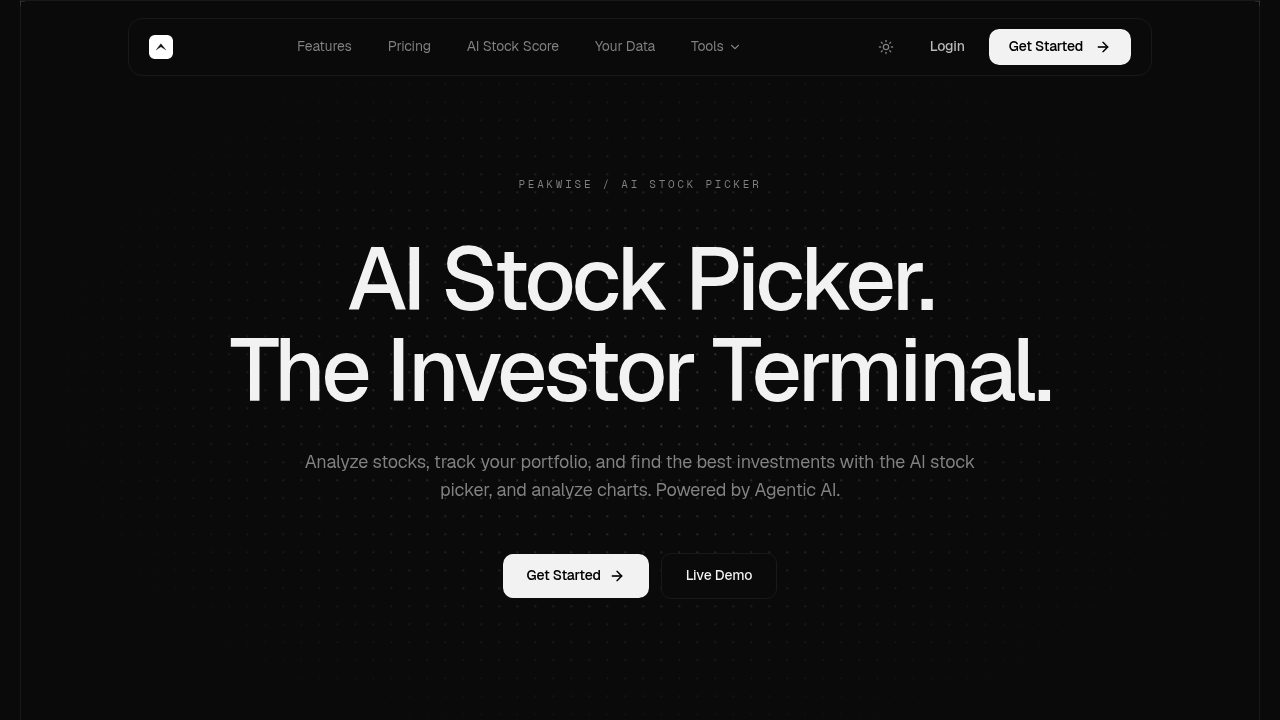
This is where tools like Peakwise change the calculus. Instead of routing your question through a single general model, Peakwise deploys 10+ specialized AI agents simultaneously, each focused on a different research dimension: fundamentals, technicals, macro, sentiment, valuation, risk, and more. You type a ticker, the agents run in parallel, and what comes back is a structured investment analysis that would have taken hours to assemble manually.
What makes Peakwise different from other AI stock tools
Most AI investing platforms do one thing well. TrendSpider is excellent for automated chart analysis. Danelfin produces explainable AI scores based on technical and fundamental factors. FinChat (now Fiscal AI) is strong for conversational queries against SEC filings and earnings transcripts.
Peakwise takes a different approach by building these research pillars into a single investor terminal, rather than forcing you to stitch together five separate subscriptions.
A few things stand out in practice:
- Daily-updated stock scores across 500+ stocks and 47 metrics — financial health, market sentiment, and valuation are scored fresh every day, so you're not working from stale data
- Model-agnostic AI access — the platform defaults to its own Peak AI multi-agent system, but you can also run your analysis through ChatGPT, Claude, or Gemini from within the same interface
- AI Chart Analysis — support and resistance levels, RSI, MACD, Bollinger Bands, and moving averages are all interpreted for you, not just displayed
- Portfolio-level risk views — geographic exposure, sector allocation, and geopolitical risk are surfaced at the portfolio level, not just for individual stocks
- Privacy by default — no broker connection, no bank data, no address required; pseudonymous use is the default
The AI Stock Market Economic Calendar is also worth calling out. Macro events move stocks, and understanding the relationship between an earnings date, an FOMC meeting, or a CPI print and your specific holdings is something most retail investors don't have time to work out manually. Peakwise does it for you.
How to use AI for stock analysis without getting overwhelmed
The biggest mistake investors make with AI research tools is treating the output as a trade signal rather than a starting point. Even a tool producing a full five-pillar breakdown in seconds is a research accelerant, not a replacement for judgment.
A few habits that make the difference:
- Start with the AI score, then dig into why. A high or low score is only useful if you understand the factors driving it. Look at which metrics are pulling the score up or down.
- Cross-reference the technical and fundamental views. A stock can look cheap on fundamentals and technically overextended at the same time. Good AI tools surface that tension; your job is to decide which matters more for your timeframe.
- Track the macro context. Interest rate sensitivity, sector rotation, and geopolitical exposure all affect stock performance. An AI tool that connects these dots to your specific holdings saves a lot of reactive selling.
- Use the prompt library. Platforms like Peakwise include pre-built research prompts that guide you toward useful questions you might not have thought to ask.
Spend fifteen minutes with a well-structured AI stock breakdown and you'll arrive at a more informed view than most investors reach after an hour of manual research. That's the actual value here.
The bottom line on AI stock analysis in 2026
The short answer to the original question: yes, there are AI tools that give you a full stock breakdown in seconds, and the gap between these tools and manual research has grown dramatically in the past year.
The tools worth your attention are those built specifically for financial analysis, not general-purpose chatbots repurposed for investing. If you're a self-directed investor who wants institutional-style research without the complexity (or cost) of a Bloomberg terminal, a platform like Peakwise sits in a practical sweet spot: deep enough to be genuinely useful, fast enough to fit into your actual routine.
Try running a few tickers through the Peakwise AI Stock Picker & Investor Terminal to see what a full AI-powered breakdown actually looks like. The first analysis tends to be the one that convinces people to never go back to doing it manually.
Frequently Asked Questions
Topics
Start with AI Stock Scoring
Score stocks with our AI Stock Score and make informed decisions.